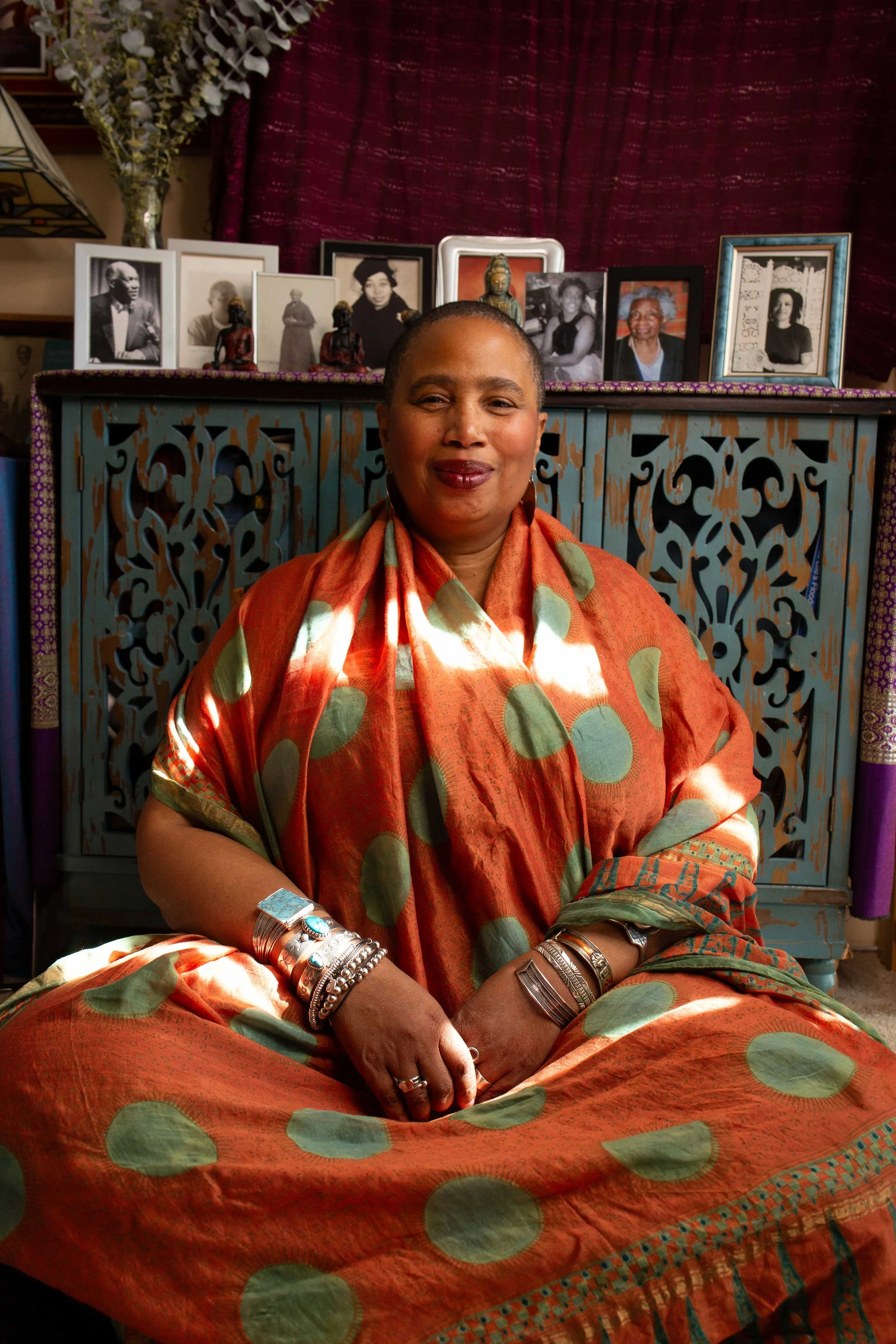
Roots and Unfolding
-
Welcome. You are arriving in a space held by ancestors, shaped by practice, and rooted in the possibility of freedom, offered in the spirit of all who carried the light before us, those named and unnamed, remembered and still becoming. Ancient wisdom and liberatory practice meet here. You are welcome exactly as you are.
Libation is the ancient practice of pouring water or liquid onto the earth in honor of ancestors, the land, and all who came before us. I offer these words in that spirit.
In many ancient cultures in Africa, Asia, and the Americas there is a shared belief that the past serves as a map for moving into the future. It is this wisdom in learning from the past which ensures a strong future. This isn't about wallowing in the past but it is about facing it, which enables us to learn from the lessons, move forward and be mindful to bring new learning and new responses.
I begin with Africa, the birthplace of all humanity. The oldest known partial fossil remains of our human ancestors, dating back 3.2 million years, were discovered in Hadar, Ethiopia, in East Africa in 1974. For hundreds of thousands of years before colonialism, African peoples built empires, developed mathematics, medicine, astronomy, architecture, philosophy, and governance. Every human being alive today traces their origin to this continent. Africa is not background. Africa is the beginning.
From that same Africa, millions were stolen over more than three centuries, more than 300 years, in what was one of the largest sustained human trafficking atrocities in recorded history. I honor the Africans and African-descended peoples whose civilizations, knowledge, and cultures shaped the ancient and medieval world long before the transatlantic slave trade. Since 1502 in Santo Domingo and in 1619 in Jamestown, VA, their uncompensated labor built economies, infrastructure, and wealth across continents. And who, in the very teeth of that brutality, gave the world Ubuntu, Ma'at, Sankofa, and knowledge spanning medicine, engineering, agriculture, science, and the arts. These are gifts without measure.
I honor Indigenous peoples across the Americas and Antilles and throughout the world, whose civilizations, knowledge systems, and relationships with the earth sustained life for thousands of years before 1492. Since colonization, their lands were stolen, their children taken, their peoples murdered. And still they preserved their languages, ceremonies, medicines, and ways of knowing. Their understanding of the earth as a living relative, not a resource, is a gift the whole world needs now. I sit on unceded Lenape territory, known as Lenapehoking. The Lenape are still here. Mitakuye Oyasin translated to mean all my relations. All things, including wind, water, and earth are connected and part of the same.
I honor Asian peoples and cultures whose civilizations have shaped the world for thousands of years through medicine, mathematics, astronomy, philosophy, agriculture, architecture, navigation, science, and the arts. And I honor the Asian ancestors and practitioners who preserved and generously transmitted the Buddha's teachings for more than 2,600 years. Since the 19th century, Asian immigrants carried these practices to the United States, holding them in secret against laws that criminalized non-Christian worship, similar to Indigenous and African-descended peoples who safeguarded their sacred traditions under threat of violence. The first Buddhist sanghas in the world were Asian. The first Buddhist sanghas in the United States were Asian. We are because they were.
I carry this with me. The harm that was done. The beauty that persisted. The wisdom that was preserved. The resistance that never stopped. The love that is infinite.
I bow with reverence and gratitude.
-
My work is shaped not only by Buddhist teachings but by the liberatory lineages that nourish and guide me. Before I came to Buddhism, I was formed by a Sufi Muslim upbringing alongside the Baptist and African Methodist Episcopal (AME) church traditions of my elders on my matrilineal and patrilineal lines, Quaker schools, camps and Meeting for Worship, and the many spiritual streams that flowed through my early life. These were not detours. They were preparation.
I am held by my claimed bloodline ancestors, whose DNA lives in my body, whose teachings, presence, resistance, and resilience make my life possible. I am also held by my chosen ancestors, including Toni Cade Bambara, Harriet Tubman, Audre Lorde, and Rev. Dr. Leon E. Wright. The insight, wisdom, courage, compassion, resistance, and resilience of these ancestors, named and unnamed, claimed bloodline and chosen, live in my Dharma, in my practices, and in my commitment to collective liberation.
My spiritual lineage reaches beyond the personal into the ancient, the historical Buddha, Kuan Yin, and the Muslim and Christian mystics whose devotion, courage, and surrender to the sacred continue to nourish and guide this path.
Beginning with the Buddha, those who precede him, and those who follow him, including his stepmother Mahapajapati Gotami and the early Theris, the awakened bhikkhunis (Buddhist nuns), I honor all of my teachers, teachings, ancestors, and communities whose wisdom sustains my path.
My Buddhist practice has been shaped by multiple lineages, each deepening and widening the path. From 2002 to 2019, I practiced vipassana meditation exclusively in the tradition of Sayagyi U Ba Khin and S.N. Goenka (Goenkaji), sitting 271 days of retreats, including two 30-day, two 20-day, two Special 10-day, two Satipatthana 8-day, and twelve 10-day silent retreats, and serving 135 days across multiple courses, often as Female Course Manager. I served on the Mid-Atlantic Vipassana Association Trust for a limited time. In 2009, I was a member of the international committee who co-organized the first 10-day vipassana meditation retreat for people of African heritage worldwide, held at the Global Pagoda at Dhamma Pattana in Mumbai, India, where I had the honor of meeting and spending time with S.N. Goenka (Goenkaji), an effort that would not have happened without the vision and leadership of B. Victoria Robertson. In the context of that historic gathering, I also had the opportunity to sit and serve in India at Dhamma Giri and Dhamma Pattana. I completed many retreats in the years that followed before leaving the tradition in September 2019. For more on my departure, including some of my many critiques and a few of my experiences of harm within the lineage, please read my essay, "It Is Well With My Soul: My Departure from the S.N. Goenka Lineage.” I also recommend “Episode #500: A Second Renunciation” of the Insight Myanmar podcast featuring Shelina Rose, a former Acharya in the S.N. Goenka Vipassana tradition, which brilliantly and compassionately articulates much of what I observed and some of what I experienced within the lineage.
Less than one month after my decision to leave the Goenka tradition, I used my frequent flyer miles to travel from Philadelphia to Spirit Rock Meditation Center to attend the public weekend of the Gathering II, a culminating gathering open to Black and African Buddhist teachers, leaders, and practitioners, following a week-long retreat for teachers of African descent. Over 300 people came together that weekend. I am grateful to Dharma Teachers Noliwe Alexander, Bishop Myokei Caine-Barrett, Konda Mason, and Rev. angel Kyodo williams for their vision and their invitational call to the Black and African sangha to come together. There will never be enough words to articulate the profundity of that experience. I am forever changed.
A month later, in 2019, I traveled to Maui, Hawai'i with my partner, now wife, Sheila Alexander-Reid. During our time there and through Rebecca O. Johnson's personal connection, we had an unexpected and extended grace-filled afternoon and evening with Kamala Masters and Steve Armstrong at Vipassana Metta on Maui meditation sanctuary. That experience opened a door I had not anticipated. Long before Maui, and long before I left the Goenka tradition, sitting with and studying the Dharma teachings of Gina Sharpe, Ruth King, and Zenju Earthlyn Manuel had already let me know there was a world of practice beyond the container I was in. Their presence was a quiet window that had been open for years before I was ready to walk through it.
It was the Insight Philadelphia People of Color sitting group, co-convened by Pamela Freeman and Sara Lomax Reese, that first opened the door from the Goenka tradition into the wider Theravāda Insight world. During a period of profound difficulty within the Goenka lineage around 2010–2011, it was this sangha that held me. Sara offered words I have never forgotten: that the practice is the practice, and teachers and institutions, being human-made, are imperfect, wisdom that helped me stay rooted in the Dharma when the container around it was causing harm. It was through this community that I first encountered Gina Sharpe and Ruth King, whose articulation of the Dhamma quietly confirmed that there was a vast and living tradition beyond the one I had known. Shortly after my return from Maui, after I shared with Pamela that I had left the Goenka lineage, she strongly encouraged me to attend a weekend non-residential with Tuere Sala, organized through Delaware Valley Insight. That weekend in January 2020 changed everything. I name this herstory here because it must be named: Pamela Freeman's vision and leadership, and the community she helped build, were essential waypoints on my path. I am now a Resident Teacher at Delaware Valley Insight, and the roots of that belonging stretch back to the sangha Pamela co-created, which first welcomed me when I had nowhere else to turn.The window that had been held open for years, my profound awakening during the Gathering II at Spirit Rock Meditation Center, and the door that opened in Maui all converged. What had been quietly preparing itself for a long time finally had room to unfold. I expanded into the Theravāda Insight Meditation tradition, where my primary teachers are Tuere Sala and DaRa Williams. Shelly Graf is also an important teacher in this unfolding.
I am also deeply nourished by the teachings of Kittisaro and Thanissara, Bhikkhu Bodhi, Bhante Buddharakkhita, Amana Brembry Johnson, and Devin Berry. I am further held and guided by the full teaching team of the 2025-2028 Spirit Rock and IMS Residential Retreat Teacher Training Program, including Rebecca Bradshaw, John Martin, and Tempel Smith, and many other teachers whose wisdom continues to nourish this path.
The teachings of Mahasi Sayadaw and the Thai Forest Tradition of Ajahn Chah are foundational to the Insight tradition in which I practice. My citta (heart-mind) is increasingly committed to the practices taught by Sayadaw U Tejaniya and teachers in his lineage, including Alexis Santos, Susa Talan, Andrea Fella, Lienchi Tran, Mark Nunberg, and Neesha Patel. While not foundational, U Tejaniya's teachings are an essential part of the Insight tradition.For two years I studied Vajrayana with Dr. Shante Paradigm Smalls. On January 3, 2022, I took vows and received the refuge name Tsultrim Chodrön, which means Discipline Dharma Torch.
On March 14, 2024, at the Garrison Institute, having completed all five mindfulness trainings and all five contemplation trainings, I received the dharma name Embodied Humanity of the Source, transmitted by Dr. Marisela Gomez and Kaira Jewel Lingo of the 43rd Generation of the Lam Te Dhyana School (Dharma disciples ordained by the late Zen Master Ven. Thích Nhát Hanh).
In May 2026, alongside Devin Berry and Gina LaRoche, I co-founded Black Liberation Dharma (BLD), an east coast-based, Black teacher-led Insight meditation community for Black practitioners throughout the African diaspora, rooted in the BuddhaDharma and collective liberation. We launched on September 23, 2026. BLD is now held by a wider stewardship circle with Keith Hunt, Jasmine Middleton, Jason Coleman and Dr. Kim Hunley. It is a sanctuary for people of the African diaspora, a place to practice Dharma together as ourselves. We gather weekly on Wednesdays from 7 to 8 pm ET on Zoom, and all are welcome within the diaspora.
Alongside sitting and walking meditation, my daily practice centers concentration and awareness practices, the brahmaviharas, Kuan Yin Dharmas, and the Five Recollections, grounded in a deep commitment to engaged, liberatory practice that turns toward suffering with awareness and compassion. Zikr (Dhikr) and African-American gospel and spiritual music are also essential parts of my sacred practices.I bow with reverence and gratitude.
-
Before Dharma became my refuge in 2002, Black feminism was my refuge. It had been since the 1980s. As a Black feminist lesbian survivor, I read the works, saw the films, and listened to the music of many Black feminists as if my life depended on it. Because it did.
There were many shapeshifters and visionaries whose work showed me how to survive. They include, and are not limited to, Sojourner Truth, Harriet Tubman, Ida Wells Barnett, Zora Neale Hurston, Ella Baker, Fannie Lou Hamer, the Combahee River Collective, Alice Walker, Toni Cade Bambara, Audre Lorde, ntozake shange, Barbara Smith, Cheryl Clarke, Beverly Guy-Sheftall, bell hooks, Paula Giddings, Sonia Sanchez, June Jordan, Octavia Butler, Kate Rushin, Michelle Parkerson, Zeinabu irene Davis, Julie Dash, and others, alongside the music of Sweet Honey in the Rock. I devoured their written, cinematic, and sonic words not as literature, film, and music but as instruction. They saved my life again and again as they formed the axis of my early survival, political clarity, and creative becoming.
At the center of that refuge were three writers: Alice Walker, Toni Cade Bambara, and Audre Lorde. Toni Cade Bambara was the one who mentored me from ages 21 to 26, shaped me, and continues, since her ascension on December 9, 1995, to guide me as an ancestral presence.
For more than three decades, my work centered the testimonies of diasporic Black survivors, breaking silences, opening portals to healing, and seeking ways to disrupt and end sexual violence without relying on carceral systems. This work was, and remains, sacred. My more than two decades of vipassana meditation, which includes a cumulative year of silent residential retreats in the U.S. and India, the longest a six-week silent retreat, supported the slow, necessary work of rooting in the mud so the lotus could emerge, in the spirit of the ancestor Ven. Thích Nhát Hanh's profound teaching, "No Mud, No Lotus."
As my life unfolded, the ground of my work widened from cultural production into teaching spiritual practices of liberation, not as a turning away, but as a continuation shaped by the ancestors, teachers, and communities who made me. Nothing was abandoned. Everything deepened. This deepening lives at the meeting place of Dharma practice and Black feminist ways of knowing, an ongoing engagement between Buddhist practice and Black feminist thought.
Black Liberation Dharma, the sangha I co-founded with Devin Berry and Gina LaRoche and now steward alongside a wider circle, is one of the living expressions of this deepening, a place where Black practitioners gather in the BuddhaDharma in service of collective liberation.
This new site reflects that deepening, a home for Dharma, mindfulness, and the embodied wisdom practices that continue to root and sustain my life.
I bow with reverence and gratitude.